
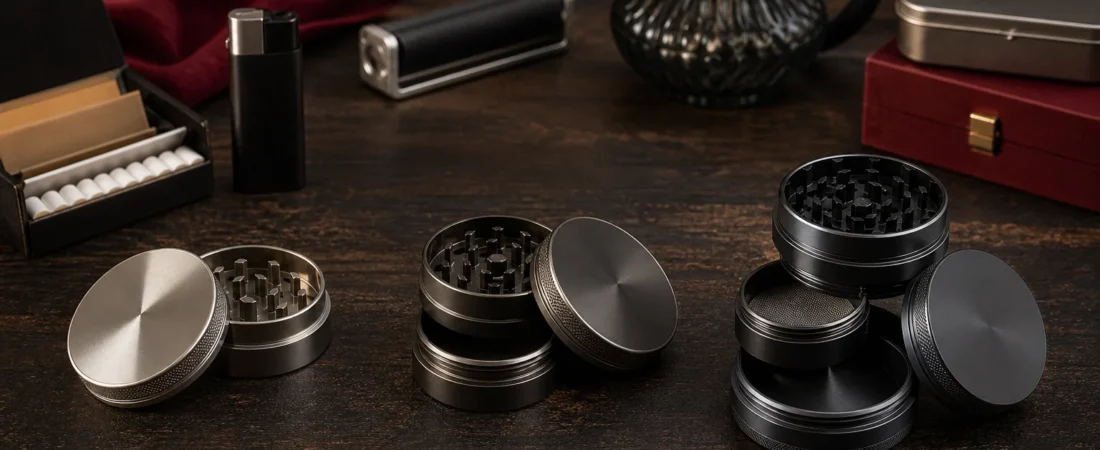
The grinder — also known as a herb grinder or tobacco grinder — is one of the most widely used accessories among roll-your-own smokers. Its purpose is straightforward: to break down loose tobacco into a uniform texture that makes rolling easier. However, not all grinders are the same. The number of pieces, the material, and the design all determine how each model performs and which type of use it is best suited to.
In this guide we run through the objective differences between the main formats available on the market, so you can make an informed choice. Please note that the sale of tobacco and related accessories is strictly reserved for adults aged 18 and over.
What is a grinder and what is it used for?
A grinder is a cylindrical device made up of two or more sections that fit together. Inside, it has teeth or pegs that shred the tobacco placed between them as one section is rotated against the other. The result is a more evenly ground tobacco than you would get by breaking it up by hand, which improves how the material is distributed when rolling.
You can browse the full range in our grinders section, where you will find models in a variety of sizes, materials and piece counts.
Types of grinder by number of pieces
The most common classification on the market distinguishes three main formats: 2, 3 and 4 piece. Each one follows a different logic of use.
2-piece grinders
These are the simplest and most compact format. They consist of a top lid and a bottom base, both with teeth on the inside. The tobacco is ground as one part is turned against the other and falls directly into the base, where it is collected by hand or by tipping the grinder.
Advantages:
- Minimalist design and easy to clean.
- Smaller size, more convenient to carry.
- Generally more affordable.
- Fewer parts that can wear out or go missing.
Disadvantages:
- They do not separate the tobacco by particle size: everything ends up mixed together in the same chamber.
- Collecting the tobacco can be slightly less convenient.
They are a practical option for anyone looking for a no-fuss, functional accessory. Browse the available models in our 2-piece grinders category.
3-piece grinders
These add a third middle section with small holes in the base. As the tobacco is ground, the finer particles fall through those holes into a lower storage chamber, while the larger pieces are retained in the grinding zone to be processed further.
Advantages:
- Automatically separates finely ground tobacco from the rest.
- The lower chamber acts as a small reservoir, useful for accumulating already-processed tobacco.
- A good balance between functionality and size.
Disadvantages:
- Slightly bulkier than 2-piece models.
- The separation holes require more careful cleaning.
They are a solid middle-ground option for those who want more than the basic model without going as far as the complexity of four pieces. Explore our selection of 3-piece grinders.
4-piece grinders
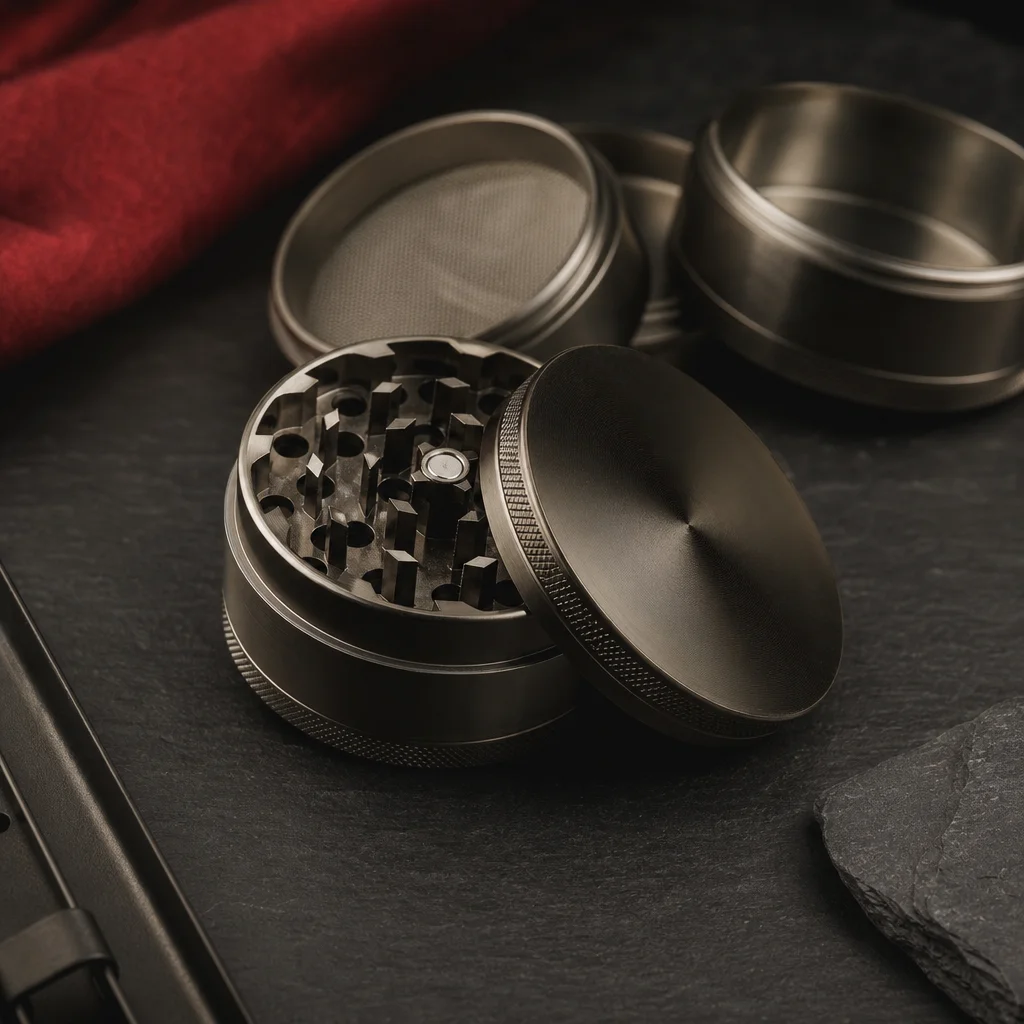
These are the most complete format. They incorporate four sections: the top lid with teeth, the grinding chamber, an intermediate chamber where the finely ground tobacco falls through a mesh or screen, and a bottom chamber — commonly known as the kief catcher — which collects the finest dust that passes through the mesh.
Advantages:
- Greater storage capacity across multiple chambers.
- Three-level particle size classification.
- Generally more refined finishes, particularly on metal models.
Disadvantages:
- Larger and heavier, less portable.
- More involved to clean.
- Higher price point, especially for metal versions.
If you are looking for the greatest level of detail in how your tobacco is processed, 4-piece grinders are the most advanced format on the market.
Materials: metal vs. plastic
Alongside the number of pieces, the material is another key factor when choosing a grinder.
Plastic grinders
These are lightweight, affordable, and perfectly adequate for occasional use or for anyone who prefers a pocket-friendly accessory without much weight. Their main limitation is durability: plastic teeth tend to wear down with regular use, and the threading can deteriorate sooner than on metal models.
Metal grinders
Metal models — typically made from anodised aluminium or zinc — offer greater robustness and a considerably longer lifespan. Metal teeth hold their edge for longer and the threading withstands daily use far better. They are the standard for mid-to-high-range models. If this segment interests you, take a look at our selection of 4-piece metal grinders, which includes some of the most fully featured models in the catalogue.
Comparison table: which grinder should you choose?
| Feature | 2 piece | 3 piece | 4 piece |
|---|---|---|---|
| Storage chambers | 1 | 2 | 3 |
| Particle size separation | No | Basic | Advanced |
| Portability | High | Medium | Medium–low |
| Ease of cleaning | High | Medium | Low |
| Durability (metal) | Good | Good | Very good |
| User profile | Occasional / minimalist use | Regular use | Heavy / detail-oriented use |
Tips for maintaining your grinder
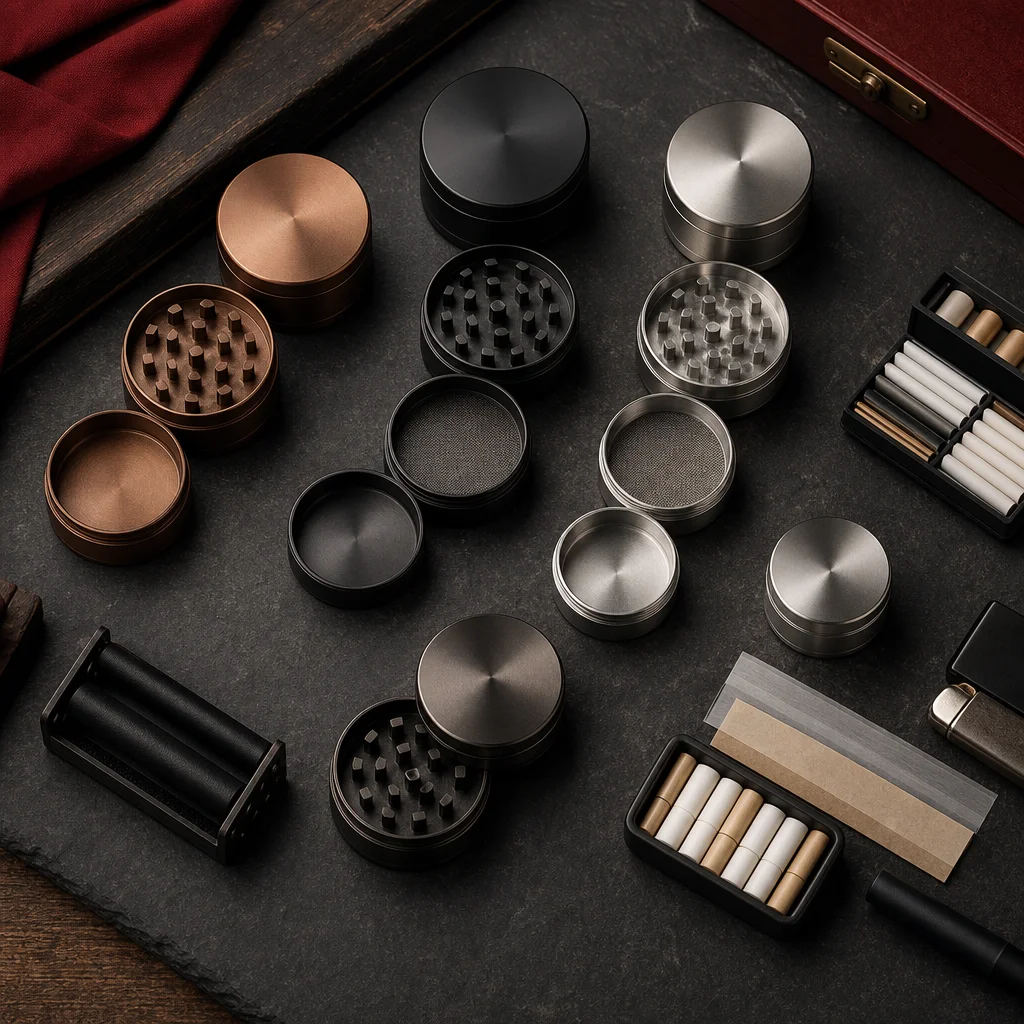
Regardless of the model you choose, cleaning it regularly will extend its lifespan and keep it working at its best:
- Disassemble all the pieces and remove tobacco residue with a fine-bristled brush or a cocktail stick.
- On metal models, a cloth lightly dampened with isopropyl alcohol helps to remove resin build-up from the teeth.
- Make sure all pieces are thoroughly dry before reassembling to prevent oxidation on metal models.
- Check the threading periodically: if it turns stiffly, a small amount of candle wax applied carefully can improve the action.
Conclusion
Choosing the right grinder comes down to three main factors: how often you use it, how much importance you place on separating the tobacco by particle size, and how portable you need it to be. 2-piece models handle straightforward, everyday use perfectly well; 3-piece models add an extra storage chamber without adding too much complexity; and 4-piece models, particularly in metal, are the most complete option for heavy, detail-oriented use.
Browse the full range in our grinders section and find the model that best fits your routine.
Everything you just read, one click away
Frequently asked questions
What is the difference between a 2-piece and a 4-piece grinder?
A 2-piece grinder grinds the tobacco in a single chamber where everything is mixed together. A 4-piece grinder has additional chambers that separate the tobacco by particle size, delivering a more sorted result and greater storage capacity.
Is a metal or plastic grinder better for rolling tobacco?
Metal grinders are more durable and hold the edge of their teeth better with regular use. Plastic ones are lighter and more affordable, but wear out sooner. For everyday use, metal is generally the more practical choice in the long run.
How do you clean a grinder?
Disassemble all the pieces and remove tobacco residue with a fine brush or a cocktail stick. On metal models, you can use a cloth with isopropyl alcohol to remove any resin build-up. Make sure all pieces are completely dry before reassembling them.
Which grinder size is most convenient to carry around?
2-piece grinders are the most compact and lightweight, making them the easiest to carry in a pocket or small bag. 4-piece models are bulkier and heavier, and are better suited to home use.
What is the bottom chamber of a 4-piece grinder for?
The bottom chamber, known as the kief catcher, collects the finest dust that passes through the grinder's mesh screen. It is the smallest particle produced during the tobacco grinding process.